Tuesday, January 21, 2014

Negotiation Skills

In our classes, we have been practicing the skills of negotiation.  According to our lessons, there are several techniques to have good negotiation, which were getting information, giving information, showing understanding and summarizing, and explaining before disagreeing.
From these skills, I would like to pick up the skill “explaining before disagreeing”.


This picture shows the effectiveness of this skill very well.


The boy explains his demand to his girlfriend in very soft way, so that she would not do “shouting, glares, or threats” to him.


And here is the example of bad negotiator.


He tried to negotiate with his boss with his salary, but his quit was not effective enough to make his boss to raise the salary.
I think in his situation, he had to give reasons why he want his salaries to raise, and what benefits he will make to his company if his payment was raised.


Johari Window and chapter 5

In our class on last Friday, we had a guest lecture about four types of leadership. This lecture reminded me of famous psychological theory, “Johari Window”.


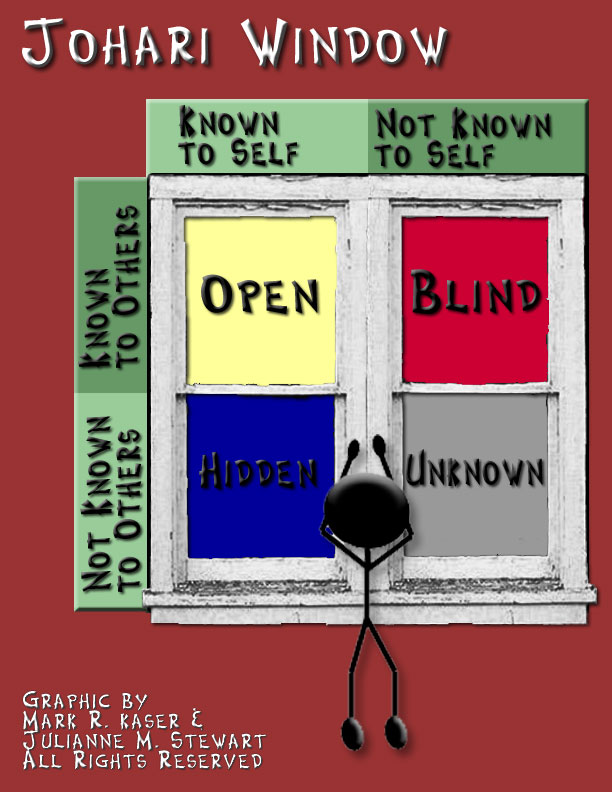
The picture below is Johari Window. There are four sections in this window about your characteristic, which are “Open Window”, “Hidden Window”, “Blind Window”, and “Unknown Window”.


Open Window is the part of your characteristic which is known to you and other people around you.
Hidden Window is the part that only you know, not even known to your family nor friends.
Blind Window is the part where other people know, but the part you have not realized by yourself.
Unknown Window is your characteristic which is not known to anybody, and have not realized by yourself. Even though no one knows about this window, psychologist Joseph Luft and Harry Ingham argues that this window exists to everybody.


I thought this idea of separating yourself is similar to what we did in the lecture and at the same time, I came up with the idea that your type of leadership belongs to Open Window, and there might be other characteristics that belongs to three other windows.


To talk about our lecture in Friday, I thought it is important for leaders to know your teammates’ type of leadership in order to be a good leader, as it is mentioned in chapter 5 of Leading at the Edge.

Picture from; 
http://notonlyluck.com/2013/10/29/the-johari-window/

Chapter 4

After reading chapter 4 of Leading at the Edge, I thought the idea of stamina was also important to our daily life, so I would like to answer questions from Expedition Log in this entry.

  1. Step back and take stock of your physical health. Are you taking care of yourself, as well as those who work for you? What more can you be doing to maintain your stamina as a leader?

    ---- I think I am taking care of myself, but I think I need to have more time to think about myself (my future?) because I did not have enough time to think about the subjects to take before winter term.
  2. Think about a current challenge, change, or “summit” that you are facing. What, specifically, can you do to keep your perspective and avoid “summit fever”?

    ---- Sometimes I get trapped in “summit fever”, that I think I have to complete something and keep other things at the side, even when I am not facing challenges. It is not specific, but as overall, I have to forgive myself when I did not complete my goal. Also, giving the order of priority is another way to solve this problem.
  3. Assess your emotional well-being and stress-resistance. Whom do you turn to when you need to vent? Identify a person, process, or activity that will alleviate and reenergize you.

    ---- Talking to my friends, taking bath, and cleaning up are the activities which I can resolve my stress. I do not know why, but when I get stressed with something, it makes me think that I have to clean my room and throw away everything.
  4. Reflect on a time when you have made a significant mistake or faced a disappointment. Did you let your feelings of guilt or frustration distract you?

    ---- When I get stressed with something, I get easily feel guilt with everything I do. However, I try to think those mistakes will cause good effects afterwards.

Sunday, January 19, 2014

Chapter 3

When I saw the title of this chapter “Optimism and Reality”, I first came up with an English comedian, Charlie Chaplin. His comedies included irony towards the movement of society. He showed people the problems of war and Natis through his comedy.
I think optimism is important for all people, not only the leaders. When I become to think negativelly, I lose my willingness to do anything. Oppositely, when I think that I can solve the problem, I can usually get it through.


Hellen Keller said;
Optimism is the faith that leads to achievement. Nothing can be done without hope and confidence.


However, people should be looking at the reality.


I think this picture shows the idea very well, because the cup is filled with water for only half, but this quote is calling it “technically full”. To be optimism is knowing the reality and changing it to possitive way of thinking.
In this way, people would be able to adjust their thoughts to the situation flexiblly, which would lead to the success.


Picture from
Daily Motivational Quotes “Optimism”


Saturday, January 18, 2014

Chapter 2

In chapter 2, the author mentions the idea of self sacrifice, as Shackleton showed by throwing his gold sovereigns into the snow.
Relating to this example, I found data about the relationship between money, love and self satisfaction.


This table shows that more you value on love than money, you will get more self satisfaction. I related this to Leading at the Edge, because I thought love is not only in the form which we usually imagine. Love can take forms as passion towards some kind of action. Shackleton had a strong wish to reach to the south pole at first, than when he decided to go back, he was strongly willing to go back with everybody in his ship alive. I think Shackleton valued his will and passion than money. This made him to through his valuables to the snow, which as a result, showed his ability as a leader.

Also, he told his clues not to throw away the things that are mentally valuable. I think Shackleton knew that love makes people happier than money, not as knowledge but by sense.